
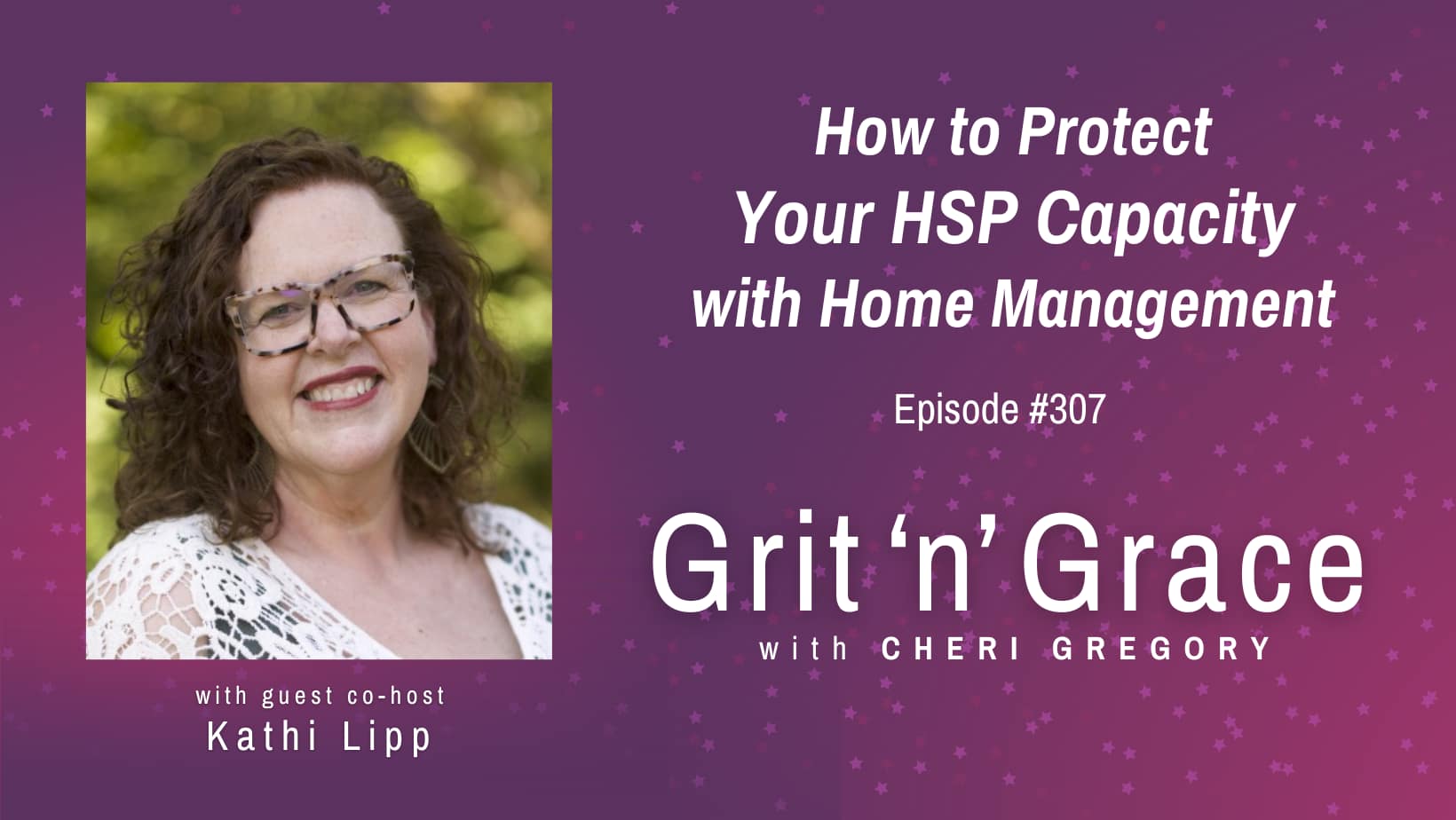
#307: How to Protect Your HSP Capacity with Home Management
How can you manage your home without draining the limited capacity you have as an Highly Sensitive Person?
In Part 2 of my conversation with Kathi Lipp, we discuss practical ways HSPs can reduce home-management overwhelm, including:
- making pre-decisions before guilt and emotion take over,
- choosing what to keep when possessions carry emotional weight,
- containing lists, notes, papers, and visible reminders,
- creating one reliable “source of truth,” and
- asking for calmer shared spaces without feeling controlling.
We also explore what may really be happening when an HSP is labeled “controlling” for needing more calm at home—and how to communicate our sensory needs with clarity and compassion.
This episode will help you approach home management with greater self-awareness, more realistic expectations, and less shame about what your uniquely-wired nervous system needs.
(This page contains affiliate links. Your clicks and purchases help support Grit 'n' Grace at no extra charge to you.)
Resources
- Kathi Lipp’s Clutter Free Academy Facebook Group
- Order Kathi’s book Clutter Free: Quick and Easy Steps for Simplifying Your Space
- Check out Kathi’s Website: https://kathilipp.com/
- Take the “Am I a Highly Sensitive Person?” Self-Quiz
- Learn about the Sensitive & Strong Community Cafe
Cheri Gregory

Through scripture and story-telling, Cheri Gregory delights in helping women draw closer to Jesus, the Strength of every tender heart.
Cheri is the co-facilitator of Sensitive & Strong: the place for the HSP Christian woman to find connection. And she’s the founder of Write Beside You coaching for HSP Christian writers, coaches, and speakers.
Cheri speaks locally and internationally for women’s events and educational conferences. She’s also the coauthor of five books: You Don’t Have to Try So Hard, Overwhelmed, and An Abundant Place (with Kathi Lipp); Sensitive & Strong (with Denise J. Hughes); and Exhale (with Amy Carrol).
Cheri and her college sweetheart, Daniel, have been married for over three decades; they’ve spent the last 19 years living and serving on the campus of Monterey Bay Academy on the central California coast.
You can connect with Cheri thru her website, on Facebook, and via Instagram.
Kathi Lipp
Kathi Lipp loves to walk with women who are decluttering every part of their lives from their homes to their unhelpful beliefs.
Kathi Lipp is the Publisher’s Weekly bestselling author of 20 books, including Sabbath Soup, The Accidental Homesteader, Overwhelmed, and Clutter Free.
Kathi is the host of Clutter Free Academy Podcast, Clutter Free Facebook Group and Clutter Free for Life community.
Kathi lives on her Red House mini-homestead with her husband Roger and 9-pound dog Moose, and regularly hosts their blended family of six, writers retreats and loads of people they love.
Connect with Kathi via her website and on Facebook.
Transcript
[00:00:00] Cheri Gregory: How can you manage your home without draining the limited capacity you
have as a highly sensitive person?
Well, in part two of my conversation with Kathy Lipp, we discuss practical ways that HSPs can
reduce home management overwhelm, including making pre decisions before guilt and emotion
take over choosing what to keep when possessions carry emotional weight containing lists,
notes, papers and visible reminders creating one reliable source of truth and asking for calmer,
shared spaces without feeling controlling.
We also explore what may really be happening when an HSP gets labeled controlling for
needing more calm at home and how to communicate our sensory needs with clarity and
compassion.
This episode will help you approach home management with greater self awareness, more
realistic expectations, and less shame about what your uniquely wired nervous system actually
needs.
Welcome to Grit and Grace, the podcast for highly sensitive Christian women. I’m your host,
Sherry Gregory.
Are you tired of the overthinking, overwhelm and exhaustion that can come with being a highly
sensitive person?
Are you ready to stop worrying that something’s wrong with you and start understanding and
nurturing yourself as an hsp?
Together we’ll build resilience, practice self compassion, set healthy boundaries, unlock your
creativity and learn to embrace, not fight, your God given sensitivity.
Let’s dig in.
Hey friend, I’m so glad you’re here. With me Today is part two of my conversation with dear
friend and longtime collaborator Kathy Lipp, and we’re talking about home management and the
highly sensitive person.
In part one we talked about why clutter can feel like so much more than just stuff, stuff for an
hsp, and also how a stabilizing day can help when your home feels completely out of control.
This time we’re moving into a different set of challenges, like making decisions before guilt and
emotion take over, deciding what to keep when objects carry stories and memories containing all
the visible reminders our brains genuinely need and communicating our need for calm to the
people who share our spaces. Now, these questions came directly from members of the
Sensitive and Strong Community Cafe, and as Kathy and I talked through them, we found
ourselves returning again and again to one central concern.
How can we manage our homes in ways that support our capacity rather than continually
depleting our capacity?
But before we dive into the questions, let me pause to introduce Kathy.
Kathy Lipp loves to walk with women who are decluttering every part of their lives, from their
homes to their unhelpful beliefs. Kathy is the Publisher’s Weekly best selling author of 20 books
including Sabbath Soup, the Accidental Homesteader, Overwhelmed and Clutter Free. She is
the host of the Clutter Free Academy Podcast, the Clutter Academy Facebook group, and
Clutter Free for Life. Kathy lives on her Red House mini homestead with her husband Roger and
nine pound dog Moose. They regularly host their blended family of six writers retreats and loads
of people they love.
[00:03:46] Kathi Lipp: Here’s Kathy.
[00:03:47] Speaker C: Okay, we’re gonna get into it. We’re just gonna dive right in. We. If you
haven’t heard part one and you don’t even know what we’re talking about, go back and listen to
last week’s podcast. We’ll put the link there in the show notes. But Sheri, my question for you is
how can HSPS pre decide in areas like purging and decluttering so they don’t get stuck in
procrastination or perfectionism? These are questions that we have cobbled together from your
sensitive and strong group, a group of hsps. And so I know that it’s so easy for all of us to get
started. Deck, Is it even harder for HSPs to stay out of the stuck zone?
[00:04:33] Kathi Lipp: I think so. And you know, part of it. One of the things in the question itself,
perfectionism. Perfectionism is the dark side. It’s kind of the flip side of the HSP strength of
being a deeply reflective thinker. And one of the things that comes along with that is we can be
accused of overthinking everything and, you know, taking it to that extreme. This is why it’s so
important to, to make those pre decisions ahead of time so that when the time comes we don’t
start re litigating things and we don’t start moving the goal posts. That’s one of the hardest things
for me when it comes to making decisions. I think I’ve made it. And then I’m like, well, but maybe
I should start over from scratch. And then I find myself using so many different standards.
Should I make it based on my own value? Should I make it based on convenience? Should I
make it based on making other people happy?
And all of that feels like then everything’s been thrown up in the air as a tossed salad and then
the safe decision feels like making no decision, which of course means we keep everything. Yes,
but that’s not the safe decision. It just means that we are making ourselves trapped and nothing
changes and we are stuck with the same amount of stuff as before. So this question is actually
really relevant to me right now because as I shared with you yesterday when we happened to
have a chance to get together this Sunday, I’m going to be having a conversation with my dad
and his wife and they are planning to sell the house I grew up in. And they have a whole list of
things they want to talk about, including books, which are my love language and a whole bunch
of other things. And even on the list they shared with us was anything that might be useful. And
I’m like, oh, no.
[00:06:12] Cheri Gregory: Oh, no.
[00:06:13] Kathi Lipp: I have to make pre decisions, Otherwise, who knows how many carloads
of stuff. Stuff I could be tempted to bring home. And part of that is my empathy. Part of that is
there’s my own emotional intensity of that’s the home I grew up in. Some of these are still my
mother’s things.
And there’s the empathy of, well, but this is my father. This is my stepmother. They want to give
things to us.
[00:06:35] Speaker C: Right.
[00:06:35] Kathi Lipp: They want the legacy to continue. They want the children to be the ones
to carry their precious belongings away, and I want to honor the them in any way that I can. And
so all of those, you know, stories that I’m telling, and it’s not just my head that’s telling the story.
It’s the story my entire system is telling.
[00:06:58] Speaker C: Right.
[00:06:58] Kathi Lipp: All of that can take over. And so pre deciding is so important.
[00:07:03] Speaker C: Yeah.
[00:07:04] Kathi Lipp: With all of those little landmines that I’ve kind of described, what kind of
advice would you give in a truly sensitive situation like what I just. What I just shared?
[00:07:12] Speaker C: I think that pre decisions is absolutely the right way to go.
And I think in a circumstance like that. Let’s talk about your dad and his wife and those things.
It’s the conversation you have with the people you live with, where you are pre deciding together
what you will bring home, what you won’t bring home.
You know, are there ten books I want to take? Not ten hundred? Because there. There could be
a thousand books that you’re.
[00:07:47] Kathi Lipp: Oh, there definitely are a thousand books.
[00:07:49] Speaker C: Yes. You know, those.
But having those discussions in advance, and I think pre decision often happens within the
context of your bigger life. You know, right now, we live in a pretty big home, but we also know
probably within the next five years, we need to sell that home because it’s sitting on 33 acres of
property. Who needs that in their 60s?
Some people would love that. But, you know, we also realize we have a balance of loving
adventure. We’re on this RV adventure right now, or we do. We.
Yeah. What’s. What’s the balance there? And so your dad and your stepmom, they don’t know
as much about your life as you do. And they say, well, Sherry loves books. Well, Sherry loves a
certain kind of book. And you have a wide variety. But maybe your father’s medical textbooks
from the 40s are not, not the thing, you know, maybe one that was precious. You know, if you’re,
if your father has a copy of Grey’s anatomy from the 40s that he learned from, maybe that would
be just the thing to bring it home. But it’s also dividing those categories. What do I bring home
that is a loving reminder of my dad? Are there things that we do need? You know, maybe they
have, you know, a KitchenAid stand mixer and you’re like, yes, please, I would love that.
Because those things could last a hundred years as well. And so you could say yes to those
things.
And I think sometimes being that I know your family is going to want you to take more than you
want to take.
And so sometimes I have to pull the.
Well, my husband and I discussed it and this is what we’re able to do. And so to honor my
husband. Now here’s the thing.
Roger would want to honor me right back. But you know, sometimes you have to use the coded
language of the people you’re talking, talking to, of course. And so to say we’ve decided we can
bring home one car load or three car loads or whatever it is, but we can’t do more than that
because also you live several hundred miles away and gas near you. You’re just telling me is
$10 a gallon.
Was that, was that you telling me?
[00:10:23] Kathi Lipp: Yeah, not too far from where I live. $10 a gallon, that’s insane.
[00:10:26] Speaker C: Like the highest I’ve seen it around here is seven something $10 a gallon.
You know, it doesn’t make economic sense so you putting those boundaries and those pre
decisions in place. But even if you’re not getting something from somebody else, just your own
current circumstances, if you have too much stuff in your house to say to, to actually put on a
post it note. I only keep clothes that fit my current body and my current life.
You know, maybe you were a teacher 20 years ago and you have your teacher outfits.
Even if you went back to teaching, you’re not going to put, you’re not going to wear those clothes
again.
You know, you’re not going to keep the uniforms from another job or. I had a lot of dress up
clothes when I was speaking, you know, I still speak, but I don’t need a bunch of different outfits
to, to speak. I need at the most four outfits to speak. So I’m going to keep the best four outfits
and get rid of the rest. I’m going to keep one memory Box per child or grandchild. That’s a pre
decision.
I donate books I would not buy again today or I don’t plan on rereading.
I don’t keep items out of guilt.
If I have not used it in a year and it’s easy to replace, I can let it go.
So those pre decisions, what I’m trying to help my HSP friends with is I want you to reduce
repeated emotional decisions.
[00:12:07] Kathi Lipp: That’s so important. One of the newest pieces of research on HSPS is
that we experience four to six times as much guilt as non hsps.
And that is just an enormous amount. And so then you couple that with the possibility of
ruminating over, well, do I keep this? Do I get rid of this? Do I keep it? Do I get rid of it? It’s just
too much. Yeah, it is too much for our systems. And so those pre decisions and following
through on them is going to. Is going to be such a relief.
[00:12:36] Speaker C: Yeah, absolutely. Okay, let’s go to the next question.
How do. And I’m happy to answer first, or you can answer first. Let’s. Whatever works for you.
And by the way, you know, when we’re talking about pre deciding, it’s making that decision when
the emotional heat is not on.
Pre deciding is borrowing wisdom from your calm self before your overwhelmed self, you know,
walks into the closet. You know, it’s like when you make your decisions when you’re not in the
midst of it, that’s going to be your best place to make that decision. Okay, number two, how do
we decide what to keep when it comes to things with emotional weight? Kids, art books, baby
gear, photos, letters and family memories.
Do you want.
[00:13:26] Kathi Lipp: Well, you started answering this one already, so go for it.
[00:13:28] Speaker C: Okay, one of the question, you know, when my dad passed away, I
wanted to keep everything because it felt like getting rid of anything was a slight to him. But
eventually I came up with the question, does this represent him that are seasoned together or a
memory of us?
[00:13:51] Kathi Lipp: Well, nice.
[00:13:53] Speaker C: So does it represent my dad well? Does it reprimand that season we had
together well, or does it represent a memory? Well, so that was something.
And then is this the best example?
Like, you know, I didn’t just keep one picture of my dad and myself as a child, but I didn’t keep
100 either.
[00:14:16] Kathi Lipp: Yeah, sure.
[00:14:17] Speaker C: I think I probably kept like seven. And for some people, they’re going to
have a lot more.
Just for me, that was the right number of times with my dad. That was a good representation.
Another question you can ask yourself is Would I go looking for this?
[00:14:36] Kathi Lipp: Oh, that’s a really good question.
[00:14:38] Speaker C: It was a very clarifying question for me.
[00:14:41] Kathi Lipp: Yeah.
[00:14:41] Speaker C: If. If I got rid of this, would I remember that I ever had it?
[00:14:45] Cheri Gregory: Yeah.
[00:14:47] Speaker C: And then about five years down the road, I was able to ask myself, am I
keeping this with love or is it guilt, fear, or obligation?
[00:15:00] Kathi Lipp: So good.
[00:15:00] Speaker C: And so that was another layer of things I was able to get.
Get out of that. Then another question was, could a photo of this serve the same purpose?
[00:15:11] Cheri Gregory: Okay.
[00:15:12] Speaker C: And sometimes the question, the answer was yes, and sometimes it was
no.
And so, like, I have a coffee grinder that my parents got as a wedding gift. Now neither of them
drink coffee. But the reason I keep it is because my brother and I got in trouble one time for
grinding dog food. Food in it. And my parents served coffee to somebody in their life that tasted
surprisingly like dog food.
[00:15:43] Kathi Lipp: Oh, that is too funny for words. Of course you had to keep it.
[00:15:47] Speaker C: I had to keep. And also, it’s beautiful. I love having it on my shelf. So it’s a
great memory.
[00:15:55] Kathi Lipp: Yeah.
[00:15:55] Speaker C: And it’s beautiful.
[00:15:57] Cheri Gregory: Yeah.
[00:15:57] Speaker C: If it was just beautiful and it had no memory attached, I don’t think I would
keep it.
[00:16:01] Cheri Gregory: Sure.
[00:16:02] Speaker C: Or if it just had that memory, I think I still would keep it even if it wasn’t
beautiful. But. Because it’s both. Yeah. So. But like kids art, almost always we can take a picture
of that and it would have the same memories for me.
[00:16:16] Cheri Gregory: Yeah.
[00:16:17] Speaker C: Baby gear. Most of that is probably out of date and just needs to be
thrown away.
[00:16:23] Kathi Lipp: Yeah.
[00:16:25] Speaker C: Photos and letters. Keep the ones that tell the clearest story.
[00:16:29] Kathi Lipp: So good.
[00:16:30] Speaker C: And you don’t need to keep the ones where people are blurry or you don’t
know who’s in the picture, that kind of thing.
You know what? You were the one who told me, when everything is precious, nothing is.
[00:16:40] Cheri Gregory: Yeah.
[00:16:40] Speaker C: And I love that so much. How about you? Is there. How do we decide?
Is there anything that I haven’t mentioned?
[00:16:48] Kathi Lipp: I think you’ve kind of alluded to this and the examples you’ve given. And
that is, for me, what’s become important is I really want to tilt towards the. The positive or the
elevated memories rather than just keep everything and kind of have this sludge that I, at some
point would have to go through.
And it’s not that I want to paint an unrealistic picture, but I. I’m not going to keep things that
make me go, oh, yeah, that was the day when. Or that’s. We had that argument and, oh, we
never did resolve that. Like, one of the things that is. Can be a challenge of being a highly
sensitive person is the natural human tendency towards a negativity bias.
[00:17:30] Speaker C: Yeah.
[00:17:30] Kathi Lipp: That can be a heavier weight for those of us who are hsps. That
overthinking that higher sense of guilt, that sort of thing. And so I’m giving myself permission to
say goodbye to things that, for me, have a heaviness to them, have a weight to them that don’t. I
mean, like the coffee grinder. I mean, my goodness, that would make me giggle.
[00:17:51] Speaker C: Right, right.
[00:17:52] Kathi Lipp: And so the things. Like, one of the things I kept for my mother was a copy
of a book called Women’s Ways of Knowing. And it turned out she read that in grad school when
she got her master’s. And I read it in grad school, and I found her copy of it filled with underlining
and annotations and even pages of notes. And I remember thinking, as I got it and I read
through her notes, I was like, it’s almost like I’m having a conversation with my MOT mother that
I can never have.
[00:18:18] Speaker C: Right.
[00:18:19] Kathi Lipp: And it’s a positive. It’s a net positive. Even though my mom and I weren’t
close, she was a perfectionist. I felt like a disappointment constantly. And so many of the things I
chose not to bring in my house.
[00:18:31] Speaker C: Right.
[00:18:31] Kathi Lipp: They would have been negative reminders, and I just couldn’t have them.
But that is a precious reminder that someday I’ll get to have more conversations with her and
we’ll be much more on the same page than we ever were when we were, you know, mother and
daughter here together. So I’m really having a bias for those things where it either is a happy
memory or it tends towards a more positive interpretation.
[00:18:53] Speaker C: Yeah. And sometimes the most positive memory you have with a person
would look like something negative to somebody else, but that’s what you cling to. That’s the
hope that you cling to.
[00:19:03] Kathi Lipp: Yeah.
[00:19:04] Speaker C: I love this so much. So one of the questions we got from Sherry’s HSP
group is what can we do when we need visible reminders like lists, notes, and papers, but those
reminders start taking over our desks and counters?
I have an answer for this. Would you like me to go first, Sherry, or do you?
[00:19:24] Cheri Gregory: Yes, please.
[00:19:25] Speaker C: Okay.
[00:19:25] Kathi Lipp: I feel very called out by this one.
[00:19:27] Speaker C: Okay. But I’m going to tell you something that is going to shock you. And I
meant to bring this up yesterday. You know how we had that. That discussion about. About
planners yesterday and how we don’t need planners, and planners don’t work for most people.
I’m using a planner, but I want to tell you the scandalous way I’m using it.
[00:19:51] Kathi Lipp: Okay.
[00:19:51] Speaker C: Okay.
So this is a planner that I feel no guilt for not using for three weeks at a time.
And then. Yeah, it’s not dated.
[00:20:04] Cheri Gregory: Okay.
[00:20:05] Speaker C: I think that’s what was killing me.
[00:20:07] Kathi Lipp: Huge.
[00:20:08] Speaker C: Huge. Yes. So this is a planner where it’s a week view at a time.
A week is on two different pages. So, yes, it has enough room for me to make lists and things
like that.
And I’m not using that planner today because today pretty much my agenda is go do laundry at
the RV park, do a couple of podcasts with Sherry, write 500 words on my book, and go out to
dinner with some friends. Like, I have other things I’m doing today, but those are the things that
need to get done today.
So I’m not using my planner today, but I used it Wednesday when I had a whole bunch of things
that I needed to check off. So on a busy day, it has from 7am to 7pm and I can write out what my
schedules in there. And then it has projects and to dos. So a project is anything that I’m in the
midst of a to do. These are my own definitions, are things that it’s going to take me 15 minutes to
get checked off.
And I. There are weeks where I’m using it every single day in that week. And then there are
times like on this trip, this is the first week I’ve used it.
And.
And I’m okay with that. And I don’t feel like I’m wasteful when I’m not using it.
And it works for me. So when I have a day where they’re like too many reminders, too many
things, I will look at my computer where I also have my calendar.
I will look at my computer where I also have some to do lists. But this gives me a very narrow.
These are all the things you need to focus on today. And that has been very helpful for me. And
I’ll put a link to that planner in our notes. I’m not saying go buy a planner. I’m not. Because that
you may just need a sheet of paper where you can write all this. But this has been helpful to me.
And it’s a way for me to focus on just what is here. And also a way to say, hey, I’ve got all these
little notes and things. I’m going to gather everything in one place and just concentrate on that.
[00:22:30] Kathi Lipp: So and for anybody who’s listening and not watching the video, I just want
to point out that you keep using your hands to demonstrate condensing, bringing things together,
putting boundaries around them, making them more manageable. Sorry, go ahead.
[00:22:43] Speaker C: Yes.
No, I. I think that that is so true.
I. Folders work for other people, they just don’t work for me. Yeah, that’s not a good.
So I.
I have one thing that has worked really well for a lot of people in my community is there’s like a
home organization file with 12 months and 31 days.
Something has shifted in my life. It just doesn’t work for me anymore. And that’s okay, I think,
because I’m much more on doing things on my computer than I am. And I don’t have that much
paper coming through my life anymore. So I just have one pile on my desk. When I need a
receipt for something, it’s in that pile. I just don’t have the paper that I used to. But for other
people that might be okay.
You know, the key is that papers need a boundary. A pile for a lot of people says everything
matters.
But I’m really trying to. My goal is to eliminate as much paperwork in my life as possible, to have
as much online as possible.
I’m so grateful to like my health that I don’t have to keep all of my medical paperwork. All of that
is online. And some people are like, they’re very paranoid about that. Then that is not the system
for you. You have to understand your own values and boundaries. But for me, perfectly fine.
Having that all online. Anything you’d want to add to that?
[00:24:15] Kathi Lipp: I think I do something quite similar to you.
I’m just sitting here thinking, because I’ve always been a scraps of paper, things flying all over
kind of person and my containment strategy. I do an online calendar. I’m not currently using a
paper planner, but there have been times that that has worked for me. But I’m realizing I have
one main kind of box where anything financial or home related just gets stuck. And then every
week I go through that, but it’s literally one place. So that’s never on my flat surfaces.
And then I live and breathe my entire life is post it notes. And I don’t. I don’t know if this one will
show up, but this is a pretty large mind post it note and Daddy’s finances.
[00:24:57] Speaker C: I saw it. Yeah.
[00:24:58] Cheri Gregory: Yeah.
[00:24:58] Kathi Lipp: Like I realized that I have a whole bunch of things that I need to get out of
my head. But rather than jotting them here, hither and yawn. I’m getting them out on the line.
Post IT notes and then those will probably end up on my schedule on my calendar.
[00:25:10] Speaker C: Yeah.
[00:25:10] Kathi Lipp: And, and then if I have enough and I need to brainstorm or, and I need to
organize things. The thing I love about the regular size super sticky post it notes, I always use
super sticky. You have to use super sticky. The regular sticky, they’ll fall off.
[00:25:25] Speaker C: Right.
[00:25:25] Kathi Lipp: But those can go on a window, those can go on a wall, they can go on this
edge of a computer. But I use foam core boards. I, my office is so covered with bookshelves. I
don’t have walls. But I’ll use a few foam core boards to organize different parts of my life so that
if I need to plan for, for Christmas then that I might have one foam core board with, with post it
notes for that. And my whole point is I use, I use post it notes because they’re movable.
[00:25:49] Speaker C: Yeah.
[00:25:50] Kathi Lipp: Until the plan kind of solidifies and then I can go onto the computer with it.
And the whole thing about that is again, it’s not things that are lying flat on my desk and piling
up. Yeah, it is.
And, and one thing per post it note, my lined one with the list is unusual. Normally I, I waste
space on post it notes. It’s one item because I need that movability.
[00:26:13] Speaker C: Right.
[00:26:13] Kathi Lipp: In case, you know, plans change or whatever. But with the goal again of it
becoming, becoming digitized with it, it being added to my schedule ultimately.
[00:26:24] Speaker C: So yeah, but the key is to have one central place. So for both of us, our
one central place is online on our online computer. I do, you know, for my focus, for my need for
focus, I do put it into a paper planner many days. But that is not my one source of truth.
And that’s what’s really important is to have one place.
You know, I get into trouble every time I try to do something from memory and I’m not looking at
that single source of truth.
[00:26:56] Kathi Lipp: Yeah.
[00:26:56] Speaker C: And so understanding that, okay, this I think is going to be very, very
helpful for many of us. When I want to hear what, what, what the thinking is for people who are
HSPs and your communication with people that they love. How can we help our loved ones
understand the impact of clutter as a visual noise without.
And you know, I hate the words controlling or critical because often that is how people receive
us and not how it’s intended.
But how do we have a healthy, productive conversation? What are some words that we can use?
[00:27:48] Kathi Lipp: Well, first of all, this is Something you’ve taught me over the years.
Conversations like this need to happen.
Not in the heat of the moment.
[00:27:55] Speaker C: Right.
[00:27:55] Kathi Lipp: Like, not when the clutter has driven somebody crazy and they’re on the
edge of their window of tolerance and about to dysregulate. They’ve just had it. Right. I’d like to
replace that word, control. We don’t want to seem controlling, but the simple fact is, is that his
humans, we should have agency. We should have at least some agency in our homes, I think.
You know, I’ve quit using the term control free.
[00:28:17] Speaker C: Yes.
[00:28:18] Kathi Lipp: I believe I’m a human seeking safety. And it’s okay to want to seek safety.
And so to have agency and to have a sense of choice in one’s own home, really, really
important. But those conversations need to happen outside of a time. Like if. If the person who
wants to initiate the conversation is feeling flooded, is feeling flustered, is feeling like. Like
they’re about to melt down or something. That’s not the time to have the conversation.
[00:28:42] Speaker C: Yeah.
[00:28:42] Kathi Lipp: And the bottom line that I have finally had to come down to is we can’t
really help other people understand anything.
[00:28:50] Speaker C: Yeah.
[00:28:51] Kathi Lipp: They have to want to understand. They have to choose to understand.
They have to have the ability to take on another perspective, which some people don’t. Some
people can only understand their way of looking at things, and if they don’t experience it, it
doesn’t exist. And so if the goal is to get them to understand so they will then cooperate with us,
sometimes that’s a losing proposition.
[00:29:20] Speaker C: Yeah.
[00:29:20] Kathi Lipp: And often HSPs tend to be very collaborative. We’re very reciprocal.
Whereas some people are very transactional. They’re less collaborative, they’re more
transactional. And that can feel really hard for us. We’re like, we want to talk it out until you
agree. And. And we’re in this together.
[00:29:36] Speaker C: Right.
[00:29:36] Kathi Lipp: And sometimes they’re not going to be in it with us. And we have to say,
this has such an impact on me.
[00:29:43] Speaker C: Right.
[00:29:44] Kathi Lipp: You may not intend that impact. You may disagree with me. I am still going
to the. These are going to be the expectations that we have. And this is what I need in order for
me to be a functional, fully functional human in this space.
[00:29:59] Speaker C: Yes. Okay. I am very passionate about this topic, and I agree with
everything you say. And oftentimes people are ask me, you know, how can I get my husband to
blah, blah, blah, how can I get my kids to blah, blah, blah? And sometimes it’s a clutter problem,
often it’s a relationship problem.
[00:30:23] Kathi Lipp: Yeah.
[00:30:23] Speaker C: And many. And if. If you have to get to the point where your spouse or
your parent or your roommate or your friend or your kids say, I don’t care that this hurts you.
[00:30:39] Cheri Gregory: Yeah.
[00:30:40] Speaker C: That is.
That’s a relationship issue. Yeah. And there needs to be a counselor involved.
[00:30:47] Kathi Lipp: 100.
[00:30:48] Speaker C: And if. If somebody at this point in my life was saying, I don’t care about
your well being, that’s a serious, serious thing that we have to take into consideration.
[00:31:00] Kathi Lipp: Yeah.
[00:31:00] Speaker C: I’m just going to say it’d be very hard for me to live with somebody who
says, I don’t care about your feelings.
[00:31:07] Kathi Lipp: Yeah.
[00:31:07] Speaker C: Because of all the humans in the world, you should care the most.
And so I think there are some ways to think, say things like when there are too many things out,
my brain has trouble filtering.
[00:31:20] Cheri Gregory: Yes.
[00:31:20] Speaker C: I’m trying to create enough calm that I can function and be present.
[00:31:25] Kathi Lipp: Yes.
[00:31:26] Speaker C: That feels like a very reasonable request to me. And then I think the next
step is to ask for specifics.
Can we keep this one counter clear?
[00:31:38] Kathi Lipp: Yes.
[00:31:38] Speaker C: Can backpacks go on the hook? And if there’s a reason why they’re
saying, no, backpacks can’t go on the hook because the last time I put a backpack up there, it
fell, you know, then let’s have that conversation.
[00:31:51] Kathi Lipp: Yeah.
[00:31:51] Speaker C: But instead of me saying, can backpacks go on the hook? And you just
saying, no, I don’t want to do that.
Can dishes go straight into the dishwasher?
Can we do a 10 minute family reset after dinner? Yeah. We’re not asking for a perfect home.
We’re asking for a clutter free zone where my brain can go and rest. You know, a calm home is
not about control. It’s about capacity.
[00:32:17] Kathi Lipp: Yes.
[00:32:18] Speaker C: You and I both believe in capacity.
And so I want to be in my best capacity for myself and for the people I love. If you want that
same thing, then these are some of the things I need. And by the way, I’m looking to do the
things that you need as well. This is a cooperation.
It’s not a competition. We’re not saying, hey, everybody is here for one person. We’re here for.
For the harmony and the peacefulness and the joy of the entire household.
So let’s work towards that. And I think, you know, Sherry, I would love to hear your last thought
on this, but I feel like this is a good place for us to end.
[00:33:00] Kathi Lipp: Oh, I. I’m just. I am camping out on that word. Capacity.
[00:33:04] Speaker C: Yeah.
[00:33:04] Kathi Lipp: That. It’s not about control. It’s about capacity. I could just feel Everything
in my heart, relax.
Especially after so many years being called a control freak. And I’ll just throw out there that
HSPS have something called fluctuating capacity.
[00:33:19] Speaker C: Yeah.
[00:33:20] Kathi Lipp: And it’s not just hsps. There’s many reasons why we might have
fluctuating capacity. And so being able to advocate for what we need to show up as our best
self. Yeah, absolutely. I love that so much. Thank you for that permission.
[00:33:37] Speaker C: And this may give insight to. Maybe you’re raising a kid or maybe you
have a roommate or a partner who you’re like, man, yeah, they would not be able to eat dinner
with that plastic tag in the back of their shirt. Or. Yeah. Noise just affects them in a different way.
And, you know, I’ve always called them high maintenance. Maybe they are low capacity, and
maybe their high is. Did you say perception?
[00:34:05] Kathi Lipp: Yes.
[00:34:06] Speaker C: Highly perceptive. Yes. And they just. They take in more information than
they are able to process. Process in a healthy, joyful way. And so if this has given you any
insight, I would love to hear about it from you, because that’s what we’re doing here. We’re
saying, just because clutter affects us differently doesn’t mean that we are less than or that we
are more than. We just, we. We all want to live in places that support our nervous systems. And
I think this is a beautiful way of saying, yeah, being there.
Sherry’s doing the Hallelujah, Amen over there. And shout out to your sensitive and strong
community. We are so grateful that you have given us these questions, that you’ve given us
these topics.
[00:34:50] Cheri Gregory: Kathy, for the listener who wants to keep taking small, doable steps
toward less clutter and more life, what do you recommend as her next step?
[00:34:59] Speaker C: If you haven’t joined the Clutter Free Academy group, I’m going to
encourage you to do so. If clutter is something you want to change in your life, this is the group
for you. We want you to be a part of this because we have the best conversations in there, we
have the most uplifting people, and we have great befores and afters where you can really
experience transformation. So all you have to do is go to Facebook, search Clutter Free
Academy. It’ll pop up. The group is named Kathy Lips Clutter Free Academy, and you’ll have to
answer a few questions to join, and we want you to be in there. It’s a great, safe place to really
work on your clutter.
[00:35:40] Cheri Gregory: Thank you for listening to Grit and Grace, the podcast for highly sensitive
Christian women. I hope this episode leaves you feeling encouraged, equipped to thrive and
ready to protect your capacity and calm.
Be sure to follow in your favorite podcast app and share this episode with a friend.
Now, if you’re brand new to the whole HSP concept, come take the Am I a Highly Sensitive
Person? Quiz.
[00:36:07] Kathi Lipp: You’ll find that link in the show notes.
[00:36:10] Cheri Gregory: And remember, God created you Sensitive in Christ, you are always
strong.
If today’s conversation has helped you recognize that home management can require more of
your HSP capacity than most people realize, I’d love to invite you to learn more about the
Sensitive and Strong Community Cafe, the HSP Resource center for Christian Women. Capacity
has become one of our major themes throughout 2026.
Together, we’re exploring what drains our capacity, what restores it, why it can fluctuate so
dramatically, and how to make choices that reflect the capacity we actually have, not the
capacity we think or we should have.
Inside the Sensitive and Strong Community Cafe, you’ll find practical resources, meaningful
conversations, and camaraderie with women who understand what looks so small from the
outside can require a great deal from an HSP nervous system. And best of all, you don’t have to
keep explaining yourself because everyone in
[00:37:18] Kathi Lipp: the cafe understands what it’s like to be an HSP.
[00:37:22] Cheri Gregory: To learn more, just go to CheriGregory.com back-slash cafe that’s C-H-E-R-I
gregory.com / cafe and of course, you’ll find the link in the show notes.
[/scroll-box]
