

#295: NOT a Bait and Switch—What Biblical Hope Looks Like in Real Life
Do you sometimes feel like hope is nothing more than a setup for heartbreak? If you’re a Highly Sensitive Person, you’ve probably spent your life preparing for worst-case scenarios and bracing for impact — especially when it feels like life keeps pulling the rug right out from under you.
In this episode, Danielle Grosse returns as my guest co-host as we explore how true hope meets us gently in the tension between fear and faith. You’ll learn how to recognize false hope, notice God’s presence in small but meaningful ways, and discover why biblical hope never rushes you, never shames you, and never disappoints you.
(This page contains affiliate links. Your clicks and purchases help support Grit 'n' Grace at no extra charge to you.)
Resources
- Episode #293: Come Out of Hiding — Your Invitation to Step Into Healing
- Episode #294: Healing at a Gentle Pace — Why We Need Gentle Words & Ample Time
- Episode #295 Transcript
- Danielle’s book The Boy, the Boxer, and the Yellow Rose: Because You’re Not Lost. You’re Healing.
- Take the “Am I a Highly Sensitive Person?” Self-Quiz
- Learn more about the Sensitive & Strong Community Cafe
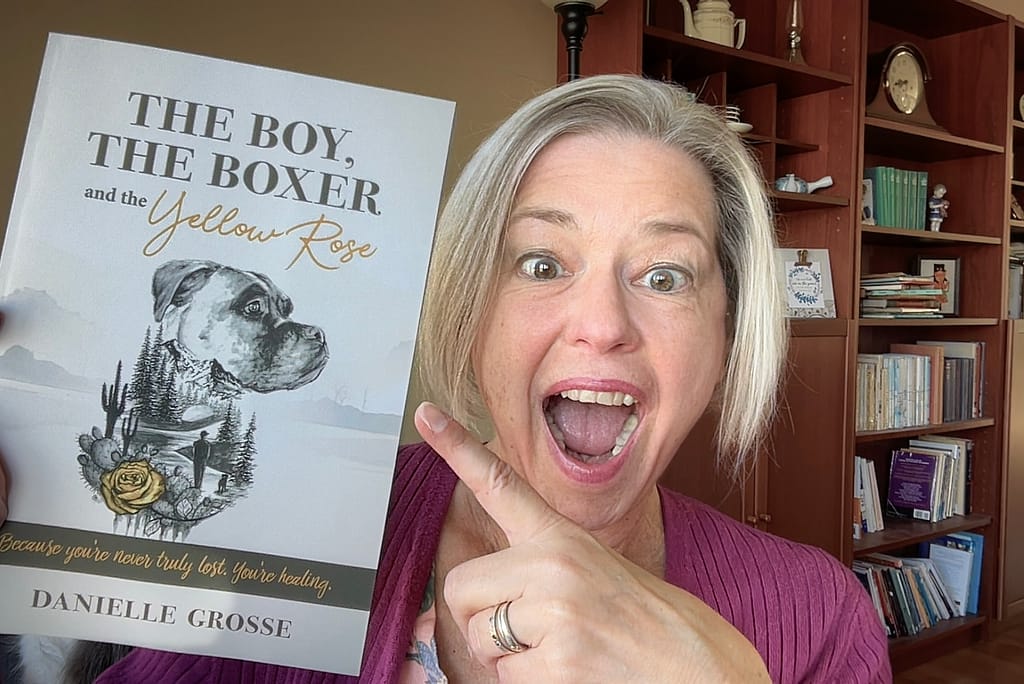
Danielle Grosse

In a world where helpers often give until they have nothing left, Danielle Grosse offers a different way forward, filled with grace, self-compassion, and a renewed sense of purpose.
Through her writing and ministry, Danielle nurtures women as they reconnect with “the Heart of a Helper” — that tender space of empathy and love for others — without falling into exhaustion or obligation.
Danielle’s passion for helping helpers heal is rooted in both personal experience and professional training which uniquely equips her to guide others through the delicate balance of helping while staying whole.
When she’s not filling the world with words, Danielle is out exploring it. Alongside her husband, Michael, she can be found bumping down roads less traveled, always seeking stories of resilience, grace, and the quiet strength of those who choose to love anyway.
You can connect with Danielle thru her website, her Facebook page, and by signing up for her newsletter.
Cheri Gregory

Through scripture and story-telling, Cheri Gregory delights in helping women draw closer to Jesus, the Strength of every tender heart.
Cheri is the co-facilitator of Sensitive & Strong: the place for the HSP Christian woman to find connection. And she’s the founder of Write Beside You coaching for HSP Christian writers, coaches, and speakers.
Cheri speaks locally and internationally for women’s events and educational conferences. She’s also the coauthor of five books: You Don’t Have to Try So Hard, Overwhelmed, and An Abundant Place (with Kathi Lipp); Sensitive & Strong (with Denise J. Hughes); and Exhale (with Amy Carrol).
Cheri and her college sweetheart, Daniel, have been married for over three decades; they’ve spent the last 19 years living and serving on the campus of Monterey Bay Academy on the central California coast.
You can connect with Cheri thru her website, on Facebook, and via Instagram.
Transcript
Transcript — scroll to read here (or download above)
****
Grit ‘n’ Grace — The Podcast
Ep #295: NOT a Bait and Switch—What Biblical Hope Looks Like in Real Life
Cheri Gregory
Do you sometimes feel like hope is nothing more than a setup for heartbreak? If you’re a highly sensitive person, you’ve probably spent your life preparing for worst case scenarios and bracing for impact, especially when it feels like life just keeps pulling the rug right out from under you.
Well, in this episode, Danielle Grosse returns as my guest co-host, and we explore how true hope meets us gently in that tension between fear and faith. You’ll learn how to recognize false hope, notice God’s presence in small but meaningful ways, and discover why Biblical hope never rushes you, never shames you, and never disappoints you.
[Intro music]
Welcome to Grit ‘n’ Grace – The Podcast for Highly Sensitive Christian Women!
I’m your host, Cheri Gregory.
Are you tired of the overthinking, overwhelm, and exhaustion that come with being a Highly Sensitive Person?
Are you ready to stop worrying that something’s wrong with you and start understanding and nurturing yourself as an HSP?
Together, we’ll build resilience, practice self-compassion, set healthy boundaries, unlock your creativity, and learn to embrace – not fight – your God-given sensitivity.
Let’s dig in!
Hey, friend, I’m so glad you’ve joined me today.
As you’re about to hear, today’s conversation was sparked because I received an email from guest co-host Danielle Grosse with the subject line ‘Are You Secretly Afraid Hope Is Just A Bait and Switch Now?’
Because of what’s happening in my own life right now – like even as I’m recording this, I’m receiving text messages from my brother because our father is at the emergency room for what feels like the dozenth time this year. So yeah, because of what’s happening in my own life right now, I have a complicated relationship with hope.
After I release this episode for you to listen to, I’m going to sit down on the couch with a couple of kittens on my lap and pray-cess “What should I do next? Should I make the 400 mile drive to Southern California again in hope of spending meaningful time with daddy and supporting his wife and my brother and my sister-in-law, or should I stay home and hope for the best?”
Danielle has asked these kinds of questions herself, and I so appreciate her gentle perspective and her hard-won wisdom.
Now, a quick heads-up before we dive in: this episode is part three of what’s now become a four part series. So if you haven’t had a chance to hear Episode 293 and 294, go back and listen to those first. You’ll find the links in the show notes.
You’re also going to hear us mention Dani’s new book, The Boy, The Boxer, and the Yellow Rose: Because You’re Never Truly Lost, You’re Healing. Here’s what it says on the back of the book:
“This is the sweet story of a college student sent to pick up a dog for his parents, only to discover a frightened boxer abandoned in a crate left behind by the very people who were supposed to love him. The boy doesn’t walk away. He kneels, he stays, and together, they begin a quiet journey of healing neither of them expected. With more than 100 expressive drawings, The Boy, The Boxer, and the Yellow Rose is a Christian fable told with gentle honesty that explores the sacred space between pain and hope, that place where love shows up and refuses to let go. Tucked within its pages are dozens of healing truths for anyone who’s ever felt boxed in by heartbreak, loneliness, or sorrow too deep to name. If something in this story feels achingly familiar, if you’ve been holding it all together on the outside but quietly falling apart on the inside, please don’t stay hidden. You don’t even have to whisper ‘Come find me,’ because love is already on its way. It’s right here in these pages, ready to meet you where you are and walk with you toward healing.”
You’ll find the link to order a copy of Danielle Grosse’s life-changing book – or a dozen copies – at cherigregory.com/episode295, or in the show notes.
So Danielle, welcome back to Grit ‘N’ Grace. We are so thrilled to have you here again.
Danielle Grosse
This is one of my favorite places. I just feel like I’m having coffee with you and a whole bunch of our friends and just inviting them into a fun conversation.
Cheri Gregory
Yes, and we have had lots of conversations over the last few weeks, and so this really is kind of just a little sneak peek into what really happens with us when we go back and forth.
I want to start us off today with an email that you sent out to your email list, and I’m one of your subscribers. it has. The title ‘Is Hope Just A Bait And Switch?’ And first of all, the title grabbed me because I’m like, “Whoa, whoa, just, way to call it like it is.” So what is it that caused you to write this email and send it out in the first place? Was it something from within? Is it something that you were hearing from your readers? What sparked this email?
Danielle Grosse
I was really surprised that when I wrote The Boy, The Boxer, and the Yellow Rose, and I was giving it to people saying, ‘Hey, you know what, this might be a pathway for you to start on the healing process.’ The most anticipated question I always receive: “Does the dog die in the end?” People are so relieved when I say “No, this is a story of hope.” This is something that we can anticipate that there will be beauty on the other side of whatever we’re going through.
And I’m always really careful when I know somebody else going through something that’s really heavy to not be the one that adds to that heaviness. And I really didn’t want that with that book.
Why are we so conditioned that when we pick up a book about an animal that we already anticipate what the ending is going to be?
Cheri Gregory
Oh, well, I used to teach literature. And, you know, I had a classroom library, and of course, we had Where the Red Fern Grows and Old Yeller. And then as a family, when my kids were younger, the book Marley and Me came out, and we read it as a family. And, you know, I read enough of these books. I know how they end. But when it came to the last chapter, Annemarie and Daniel bailed. They were like, “No, this is that chapter.” And they felt betrayed. They felt betrayed by the author. And it was Jonathon and I who made it through the end.
And when I say we made it like I would read, and then I would break down sobbing, and he would sob, and then I would hand him the book, and he would read, and he, until he couldn’t read any longer. So we limped through the end of that. And I’m not saying one reaction is better than the other. I understood why Annemarie and Daniel bailed. I understand why Jonathon and I chose to go through it. It was brutal. But we do, many of us have this history where we fall in love with the animal character, only to have to say goodbye to it at the end.
So yeah, it’s definitely – that bait-and-switch, that ‘I’m going to pull the rug out from under you’ feeling is very strong,
Danielle Grosse
And it’s not a gentle – or, I mean, it might have some release; like, if you’re holding a lot of emotion back and you’re afraid to deal with loss or something, that might have its place. But I also think that hope is just so misunderstood sometimes that we really need to be careful with how we pursue hope or extend it to someone else. God doesn’t do a bait-and-switch. He doesn’t pull us into this trap and say, “Hey, you know what? You can believe in this, and I’m going to get you this far, and then I’m going to completely change your circumstances again, and you’re going to have to hurt all over again.” God always has it in His heart that His goodness shows through you.
Cheri Gregory
And I have talked about – and I don’t even like to use the word ‘hope’ for this, but we’ve talked about something, we’ve kind of coined false hope that people like to try to give each other, or maybe they’ve been conditioned to where it’s just what’s most comfortable to them. And at least in my perspective, especially with some things I’m going through in my life right now, I’m going to say that that kind of hope seems to sometimes bypass reality.
So in your experience, you know, what can that feel like? What can it look like? What can it trigger inside of us?
Danielle Grosse
I think one of the main triggers that I look for when I see something that’s maybe giving me false hope is it requires me to meet unobtainable deadlines.
Cheri Gregory
Ooh.
Danielle Grosse
You know, there are some things that our body can do, our emotions can do, and our mental state can do, depending on where we are in the process of healing. And so if we are right in the beginning where the pain is just so intense, we are going to have a harder time setting goals or benchmarks that say, “Hey, I’m better now.”
And what I found, as I was trying to heal from the fall that I had taken, I would give myself these deadlines, and I would say, “You know what, I will feel better. In three more days, this is going to be over.” And in three more days, the pain stayed the same. I was always trying to require unobtainable deadlines from myself that just were not physically possible. And I think that part of false hope is we want to prevent further problems, maybe rather than assess right where we are.
And I think you and I have really talked about using assessment as a way to take away denial and maybe bring ourselves to where the truth of the situation really is.
Another thing that I’ve really been toying with hope is when we set that deadline, God’s going to see the timing of things a lot differently than we do. You know, because he doesn’t just see everything from our perspective. He’s going to want to bring someone else who may be further behind us. He may want to catch them up, and so we may have to wait for them, for them to be part of where we’re going. And so –
Cheri Gregory
I’m gonna just interrupt you to say I have seen that in so many relationships, where I was like, where I wanted to hurry someone along, because I felt like I was making good progress, and I had hoped that they would make, you know, good progress, too, but there was just so much hidden agenda and so much expectation in all of that, rather than true hope. Sorry, go ahead.
Danielle Grosse
I think that is such a good point, Cheri, because then it not only makes you responsible for where you are, you’re feeling that responsibility for someone else and for their emotions and where they are, their mental state, and really it’s where we are and how we are, taking someone’s hand and walking with them. So we all kind of move towards this true hope together.
Cheri Gregory
Biblical hope is such a profound and anchoring concept that I want to really protect that word. And so other terms that I feel more comfortable using when we’re talking about kind of this false hope that has these huge unrealistic expectations or these deadlines on them – and I remember when you were in Scotland and after you’d had your injury, and you kept saying things like, “I’ve really turned the corner now, you know, I’m really on the road to recovery this time.”
And I remember thinking to myself, “Wow.” I mean, I admired, I absolutely admired your spirit. But I’m like, “Oh, I recognize that. I recognize that desire to be able to say ‘Today is day one of the full recovery,’ or ‘Yesterday was the end of the bad season, and now we have started the new season.’” That is such a human thing to do, is to want to be able to say, “Yes, I know, I know, and it is measurable and it is quantifiable that from here on out, it’s just going to be getting better and better.”
But anyways, other terms that I think can be helpful, especially for us as HSPs, to have that more nuanced vocabulary, are things like magical thinking. Sometimes I’ll say, “Oh, I’m off in fantasy again.” Or, you know, sometimes we refer to it as denial. And my husband’s always saying “Denial isn’t just a river in Egypt.” Toxic positivity. There are parts of my family that I just, I very much feel that way. They will say things are fine when they are documentably not fine.
And then I’m going to put a link in the show notes to a really great article by Emily Freeman, in which she talked about something she referred to as a ‘wish sandwich.’ It’s defined as saying yes to the possibility of something rather than the reality. And I just feel like that’s such a fine line, because hope says we want to be optimistic. Hope says we want to be forward thinking. And yet, possibility versus reality, that is such a tender liminal space.
Talk to us about really, what do you see as true, Biblical hope – not false hope or magical thinking or any of these other things that I just described. But what does hope mean to you?
Danielle Grosse
I think there are a couple of ways that we can look at two kinds of hope. There’s the kind of hope that you notice, and then the kind of hope that you carry with you.
Cheri Gregory
Ooh, unpack that.
Danielle Grosse
So that hope that you notice, it’s the way of seeing God’s presence in your situation. And sometimes that comes from a friend that picks up the phone. They listen to the Holy Spirit and they say, “You know what, I just couldn’t get you off my mind today. How are you?” And you’re suddenly like, “You know what? That phone call didn’t just come out of the blue. God had a hand in that.”
Or it can be something as easy as like, a verse that comes back to you, a Bible verse, and you hear it like three different times, and you go, “Hey, wait a minute, God’s telling me something here.” And I love the ones that have God’s previous knowledge of where we would be inside them.
And I’ll give you an example of that: you know, I didn’t know that I was going to write this book, and I was going to call it The Boy, The Boxer, and the Yellow Rose. And I was thinking the other day, I was like, you know, “I kind of wish my mom could have read this book.” And it wasn’t 20 minutes later. I was unpacking a few things, and I found this antique pin that she wore when I was a child.
Cheri Gregory
Is that a yellow rose?
Danielle Grosse
It is a yellow rose.
Cheri Gregory
That is amazing.
Danielle Grosse
And I went, “Wow, God, that was a little thing. But you showed up and You said, ‘I knew you were going to write this book. I knew you were going to miss your mom at this moment, and I’m still right here.’” And I think those are the things that when we’re in pain, sometimes they’re hard to notice.
Cheri Gregory
Yes, you know, yes, oh, I love that. So hope you notice is these signs that God is near. You know, I’ve heard them in just kind of societal, maybe psychological parlance, referred to as ‘glimmers.’ But I love that. In this case, you’re saying it’s not just a glimmer. It is actually a sign that God is near.
Danielle Grosse
And He does that, and I think he likes to tap us on the shoulder gently and say, “Hey, you know, I’m still here.”
And the other thing that I think is that kind of hope that we carry with us, okay, and it’s not dependent on the circumstances we’re in. Sometimes it’s saying “I’m going to walk towards hope with gentle steps.” Or it can also be being willing to, like, stick out a hand and say, “You know what? I need for someone to walk with me as I’m going through this.” And some of that is a decision, like, anytime you decide to forgive, I think that is a sign of carrying hope with us.
Cheri Gregory
Oh, absolutely, absolutely, yeah.
Danielle Grosse
And sometimes it’s just getting out of bed. It’s just getting out of bed and saying, “You know what, I’m not going to let grief defeat me. I’m going to get out of bed, and I know that the day will be even better.”
Cheri Gregory
I love that. I love that. Well, and back to your idea that these don’t depend on the circumstances. You know, I know there’s been situations where I’ve been like, “Okay, I can’t face today, but I think I can make it to the shower,” right? And if I get in the shower at some point, I’m going to get out, and then I can probably dry off.
And so rather than overwhelming ourselves with these huge deadlines, these huge expectations, to be able to say, I’ll take that next – Kathi Lipp calls it not even a baby step, but a micro step.
And I agreed very quickly with you, “Oh yeah, forgiveness is hopeful.” And I’m like, “Yeah, me and forgiveness have a complicated relationship,” so I’m going to say that sometimes I’m not willing to forgive, but I’m willing to be willing, and that’s a huge step. I’m willing to be willing to receive whatever the next prompt God wants to give me, and I’m willing to respond to that.
And like you said, He’s always so gentle. There are some people for whom I know white knuckling it and forcing themselves to do things seems to be what works for them. I’m not one of those people.
Danielle Grosse
Me neither.
Cheri Gregory
And so anytime that we can break things down to those micro and gentle – and I don’t mean pandering to ourselves, but I do mean the times I’ve forced myself, and I’m talking both physically and also emotionally and spiritually and relationally, the times I’ve forced myself sure I got the result in the moment, but then it took months, if not years, to repair the damage that I did either to myself, and then sometimes that damage had a ripple effect. So I love this much more gentle approach.
Danielle Grosse
I had kind of an example, and it relates back to our last podcast, when we were talking about, “Hey, God, I’ve got this. Don’t worry about me. I’m a-okay.”
So when my daughter Jordan got married, it was up in the mountains at this beautiful place called Crystal Mill. And Jonathan’s parents own the ranch up there, and it’s one of the most iconic locations for photographs in the state of Colorado. It’s an old mine, and right below it is this big, huge, I’d say, pond, but it doesn’t have a bottom to it, right? It’s fed by the snow, and it’s very, very cold.
So the day after they got married, we were up at a cabin, and Jonathan said, “Hey, we’re gonna go swimming at the mill.” And I was like, “Yeah, I’m up for that.” Because, you know me, I am such a water person, and I love to swim, and I love to be in the water, so they get up on this huge cliff, and I’m like, “You know what? I’m not, I’m not a cliff diver. What do – is there an alternative?” Because I wanted to be part of what was going on, right? And Jonathan goes, “Yeah, you can just go over there. It’s about 100 yards, and you can swim over and meet us.” Easily done, right?
They jump off the cliff. I’m over on the other side. I jump in the water. I’ve got this. I’ve been a master swimmer, and let me tell you, I was not prepared for the intensity of the cold water. Suddenly, I’m halfway through, and my limbs are weak, like there is nothing left in me, and I keep going, and by now I’m starting to dog paddle, right? Because I’m thinking, I don’t know, “There’s no bottom to this. I have to keep going.” I was, that was one time in the water it was like, absolutely panicked, right? And Jonathan’s standing on the other side. And I think, I don’t want to say, “I need some help here,” you know, like, and how many times we do that with God, you know, we’re just finally, we get to that spot where we’re in the dog paddle, and we go, “What am I going to do?”
And I can, I’ll never forget, I hear him yelling at me, “Hey, Doc, you’ve got this.” And I’m like, okay, three more strokes and I’ve got it. And I look up and his hand is reaching out over those three strokes and pulls me to the shore. And you know what? That’s what hope is. When we are just dog paddling, and we think, “I just am not going to be able to do this anymore.” And then there’s this connection.
And I think that one of the things that sometimes we miss with Biblical hope is that deep connection, when God sends us someone who’s a conduit that will reach out that hand and come to us. Sometimes, I think before we get to hope, we’re not really careful. There’s this element of blame. “God, why did you do this? Why did you allow this to happen?”
I found a verse that I feel is like one of the most hopeful verses in the Bible, and I think it would be really unexpected. It’s from 1 Kings Chapter 19, and it talks about when Elijah runs to the cave because he’s hiding. He’s scared. He’s isolated himself. And it says so after the earthquakes, because he’s looking for God in the situation, right? Where are you? Where are you?
“After the earthquake, there was a fire, but the Lord was not in the fire. After the fire, there was a quiet, gentle sound. When Elijah heard it, he covered his face with his coat and went out and stood at the entrance to the cave. Then a voice said to him, ‘Elijah, why are you here?’” And I think that just for me, when I have been like, God, where were you in the disaster? Where were you? And He wasn’t in any of those things. He was that whisper that comes along and says, “Why are you isolating yourself? Why do you want to be alone? I’m here, and I’m the one that will show you my goodness every day. I am the one that will fulfill my promises that I’ve given to you, and you don’t have to rely on your own sense of hope.”
Cheri Gregory
That is so powerful. I’d not seen that portion of Elijah’s story in that way. “Why are you isolating?” And God coming in the gentleness.
Be sure to join us next week as Dani and I continue our conversation about why true hope is not a bait-and-switch, and what Biblical hope looks like in real life.
You’ll find the link to order a copy of Danielle Grosse’s powerful book, The Boy, The Boxer, and the Yellow Rose: Because You’re Never Truly Lost, You’re Healing at cherigregory.com/episode295 or in the show notes.
Now, as we’re wrapping up, here are a few reflection questions for you to process and possibly even journal about:
Number one: Where in your life have you been bracing for disappointment, perhaps even in your relationship with God?
Number two: When have you clung to false hope, like unrealistic deadlines or wishful thinking without realizing it at the time?
Number three: Which signs of the hope we notice have shown up in your life recently?
Number four: What does the hope we carry look like for you right now?
And number five: How might God be speaking to you the way he spoke to Elijah, not through an earthquake or fire, but a gentle whisper?
Now, speaking of the hope we notice, if you noticed some unusual sounds in the background of this episode, you were not imagining things. I had gotten my podcasting equipment all set up, and the moment I hit record my two kittens, Darcy and Georgiana, and my daughter’s cat, Zaboomafoo, they all descended on me with toys and proceeded to run a literal three ring circus. I could hear that in the background, and my old perfectionism started to rise up.
But here’s the thing – we’ve noticed something about Georgie: whenever someone is sad or stressed, she brings a toy. And this has happened too many times now for it to be a coincidence. A few weeks ago, when I was verbally processing my concerns about my father’s health with my husband Daniel, and I started to get tearful, out of the blue, Georgie hopped into my lap and dropped a felt mouse into my hands.
And she’s even intentional about what she brings to whom, like she always brings a feather stick to Darcy because she knows it’s his favorite toy, but when one of us humans are sad or stressed, she brings us her favorite toys. It’s almost as if she’s saying playing will make you feel better. Not only is she right, but I’ve come to see this endearing little quirk of hers as one more example of the hope we carry a silly yet significant sign that God is near.
Thank you for listening to Grit ‘n’ Grace – The Podcast for Highly Sensitive Christian Women!
I hope this episode leaves you feeling encouraged, equipped to thrive, and held by true hope!
Be sure to follow in your favorite podcast app and share this episode with a friend!
If you’re brand new to the whole HSP concept, come take the “Am I a Highly Sensitive Person?” quiz — you’ll find that link in the show notes.
And remember: God created you sensitive; in Christ, you are always strong.
If today’s conversation with Danny reminded you how powerful safe connection can be, you will love the Sensitive & Strong Community Cafe. It’s where HSP Christian women gather to reflect, to share, and to grow through seasons of hope, healing, and everyday life.
Here’s how one Cafe member describes her experience. She says:
“I was actually scared to join and nervous to find out more about being an HSP or open up about who I really am, but the cafe has become my safe place, where I feel so much connection and support.”
To learn more about the Sensitive & Strong Community Cafe, go to cherigregory.com/cafe, and you’ll also find the link in the show notes. We would love to have you join us.
